
10 Sales Funnel Mistakes That Are Hiding In Plain Sight.

A broken sales funnel
Did you know there are ten sales competencies you need to master to be able to say you run a truly buyer-focused business?
In 2020 we launched a Sales Funnel Self-Assessment to help you understand where your business is at in that regard.
Between September 2020 and December 2024, our Sales Funnel Self-Assessment received more than 400 responses from sales professionals and business leaders across Australia and the USA.
Below, I’m giving you valuable behind-the-curtain insight into where businesses are failing.
Where Businesses are Failing.
The results were damning. So many opportunities are being missed on a daily basis, and so many improvements that could be made, but weren’t.
Below is a list of the 10 most common sales funnel pitfalls, together with proposed mitigation strategies, based on key insights from the study.
1. No Brand Promise.
People often make a buying decision with their heart, and then try to justify it with logic afterwards. In sales emotions matter, and it is important that we send out a very clear message to our prospects about what customers’ experience they can expect when they become our customer or client.
60% of respondents do not have a clear brand promise.
2. Unclear Products And Services
Sales organisations have trouble articulating to their customers exactly what they are trying to sell to them. Half of all respondents do not have a clear definition of their products or services which poses the question – are we confident that our Prospects and Customers understand our products and services right from the start?
A full half of respondents do not have a definition of their products or services that’s clear to their customers!
3. No Unique Selling Proposition (USP) And Killer Business Introduction (KBI).
Your value proposition must be more than a mere motherhood statement, such as: “We really care”. Instead, it needs to be hugely credible and must easily distinguish your business from that of your competitors, and you need to be able to back your statement up with evidence.
80% of respondents do not have an effective selling proposition with which to attract and engage their ideal customers. This often creates a huge top-of-the funnel problem with insufficient sales leads and poor conversion rates.
80% of respondents do not have an effective selling proposition, let alone a KBI.
What is your Unique Selling Proposition? I.e. can we clearly state what makes our business and its offerings unique, and why a buyer should absolutely be interested in what we do? What makes us and our business different from that of our competitors?
4. No Ideal Customer Profile.
Just under half of all respondents are unsure of who their ideal customers are. This often results in poor prospecting results and wasted lead generation efforts, leading to frustrations and low morale.
Just under half of all respondents are unsure of who their ideal customers are.
There is little point in engaging with the wrong kind of prospects. You are better off engaging with the right kind instead.
How clear are we on what our ideal customers look like, in terms of industry sector, size of their business, their geographic location, job title, their challenges, their opportunities, their ambitions and motivations, etc.?
5. Not Understanding Where To Find Ideal Prospects.
More than 60% of respondents are unsure of WHERE to find their ideal clients. This creates problems with prospect engagement, poor sales quota attainment and loss of market share.
More than 60% of respondents are unsure of WHERE to find their ideal clients.
6. Not Knowing How To Engage With Ideal Prospects.
A combined total of more than 80% of respondents do not know HOW to engage their ideal customers in a sales conversation. This is THE KEY CHALLENGE IN SALES TODAY. Ineffective prospect engagement kills your pipeline, waists your sales leads and creates an army of unimpressed prospects for your brand.
More than 80% of respondents do not know HOW to engage their ideal customers in a sales conversation.
Once you know WHO your ideal customers are, and WHERE you can find them, the question turns to HOW to engage them in a meaningful way that draws them into a sales conversation.
7. No Skills To Eliminate Competitors
More than 70% of respondents say they are ill-equipped to fend off their competitors. This results in too many lost deals that should have been won, unpredictable forecasting and messy pipelines.
More than 70% of respondents say they are ill-equipped to fend off their competitors.
Let’s say you successfully engaged with a prospect. You are in the running now to win this deal. However, very rarely will you be the only seller in this race. Instead, you will most likely have to beat off any number of competitors.
How good are we at fending off our competitors, and ending up our Buyers’ one and only choice?
8. Not Using A Sales Proposal Process To Close More Deals.
There is often a degree of confusion between the sales proposal content and the sales proposal process. Sure, what goes into a sales proposal is important, but the way it is presented is also critical to its success.
More than 70% of respondents say they do not have a sales proposal process to help them win more business.
9. Ignoring The Customer Experience
Most businesses understand how mission-critical the customer experience is to the success of a business at every step of the way. But do we really know how well, or how poorly, we are doing in that regard?
70% of respondents don’t seem to be fully focused on their customers.
Is this something they just don’t take seriously in their business? Is it a matter of culture? Is it a matter of leadership? Are the wrong KPIs and metrics driving this behaviour?
10. Not Using Referral Selling To Win Repeat Business And New Logos
The experience our customers have with us does not end with a purchase or a transaction. The post-sale experience is critical insofar as it will determine whether they will choose to come back to do more business with us, or not.
Just under 60% of respondents admit that they do not have the ability to turn their turn customers into repeat customers and advocates who refer new business.
Will your customers rave about you, or will they rant? Is their experience a pleasant one that will make them recommend you to their friends and colleagues? Or is it one that will more likely make them warn people off doing business with you?
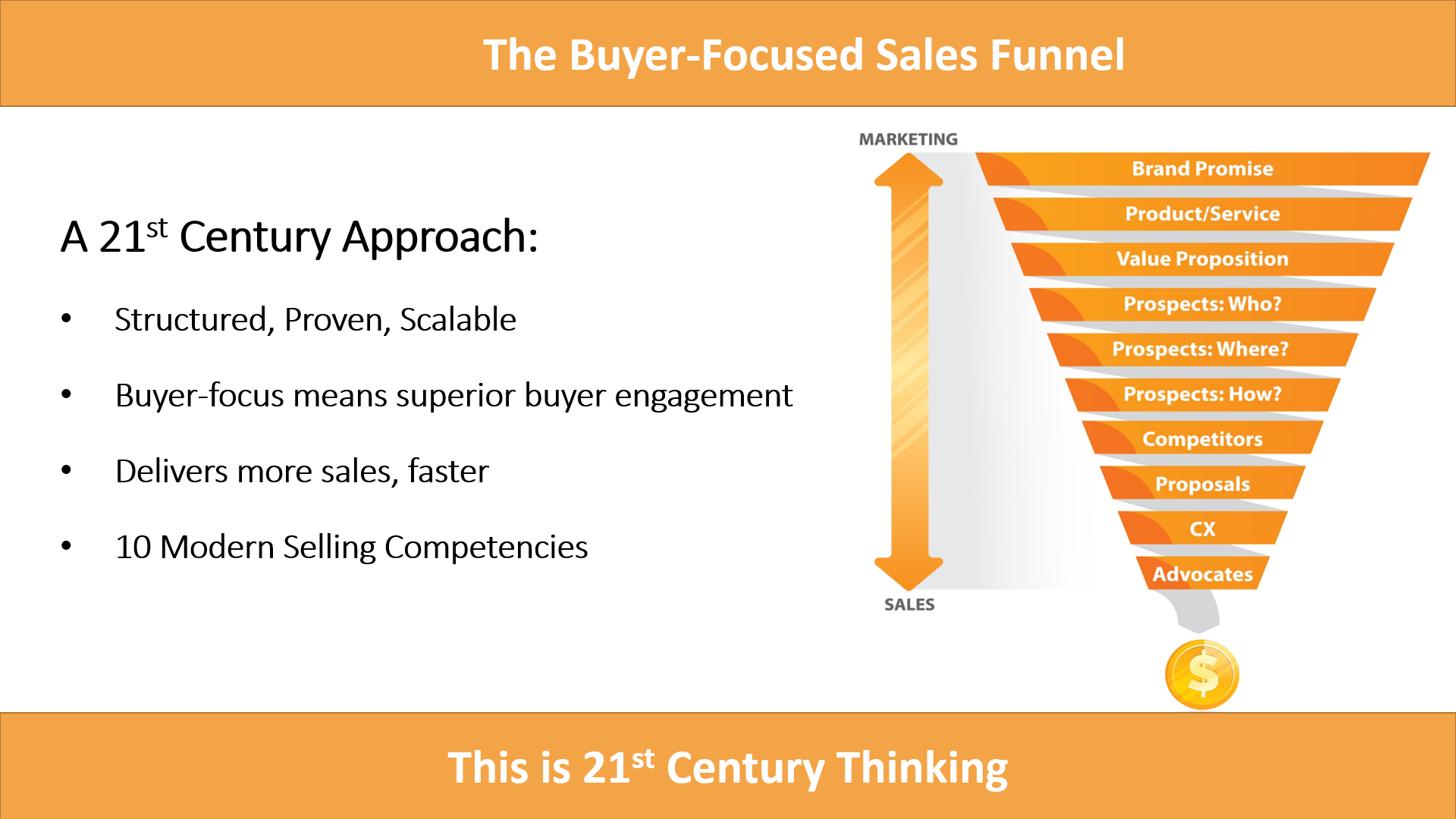
The Buyer-Focused Sales Funnel for innovative businesses that want to grow their sales revenues.
Conclusion And Takeaways
No business should rest on its laurels, there is always room for improvement.
Real leaders are not afraid to ask for external help, advice and guidance.
The report clearly shows that there are enormous untapped opportunities for improvement, to lift sales, to give customers a better experience, and to grow the business.
What Are YOU Going To Do About It?

Schedule a call with Peter Strohkorb
Take our Funnel Self-Assessment